
I Thought Debate Was About Winning Arguments. UTNIF Taught Me It’s About Winning People.
I went to University of Texas - Austin's Congress Debate Camp thinking debate was all about having the best arguments. I left realizing the biggest lesson had nothing to do with evidence. Here are the five skills that completely changed how I approach Congressional Debate and public speaking.
Aliya K Sil
7/19/20262 min read
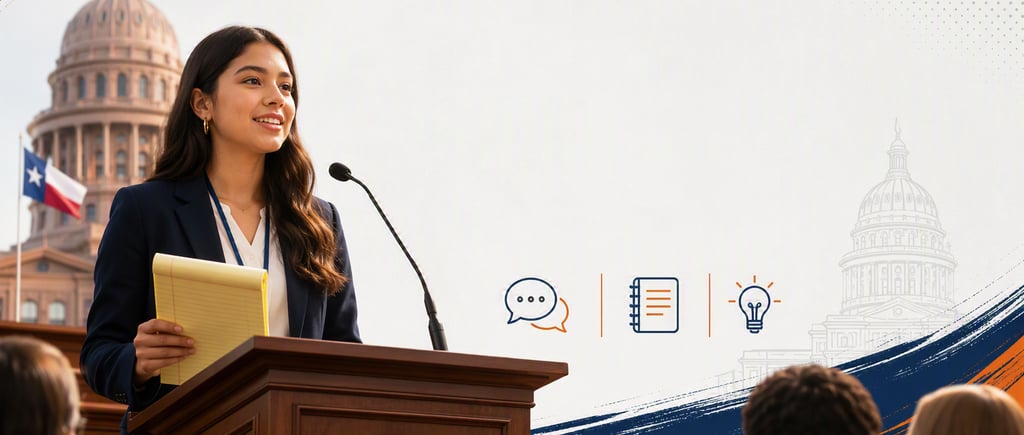
What makes a great speech?
Before attending the UT National Institute Forum (UTNIF) Congressional Debate Camp, I would have said it's all about having the best evidence. After spending a week learning from incredible coaches and debating alongside talented students from across the country, I realized something much more important:
The best debaters don't just present facts—they connect with people.
That one lesson changed the way I think about public speaking.
Here are a few of my biggest takeaways from camp.
1. Don't Repeat Yourself—Crystallize the Debate
One of the coolest skills I learned was crystallization.
Instead of trying to cover every argument that had been made, I learned to step back and answer one simple question:
"What actually matters most in this debate?"
A strong crystallization speech doesn't just summarize. It helps everyone in the room understand which issues deserve the most weight, compares both sides fairly, and explains why your side should win.
It felt less like giving another speech and more like helping solve a puzzle.
2. Your Notes Are a Safety Net, Not a Script
Like many debaters, I relied a little too much on my legal pad.
At camp, we practiced speaking with our notes instead of reading them. Simple habits made a huge difference:
Memorizing transitions
Looking up after every sentence
Using notes as reminders instead of a script
Making eye contact during key moments
The result? My speeches sounded much more natural—and I felt far more connected to the audience.
3. Your Body Speaks Too
Before camp, I barely moved while speaking.
I quickly realized that confidence isn't just something people hear—it's something they see.
I started practicing purposeful hand gestures, standing with an open posture, moving naturally, and facing different parts of the room. None of it was over-the-top. It simply helped reinforce what I was saying instead of distracting from it.
4. Facts Matter. Emotion Makes People Listen.
This might have been my favorite lesson.
Evidence wins debates—but only if people care enough to listen.
By changing my pace, emphasizing important words, pausing before major impacts, and showing genuine emotion when discussing real people and real problems, my speeches became much more engaging.
I wasn't just reading evidence anymore.
I was telling a story.
My Biggest Takeaway
UTNIF reminded me that great Congressional debaters do much more than memorize evidence.
They organize ideas clearly.
They simplify complicated debates.
They speak naturally.
They connect through eye contact and body language.
And most importantly, they make people care.
I still have plenty to learn, but I left camp feeling more confident than when I arrived—and excited to keep improving throughout the season.
If you're interested in debate, public speaking, or helping students develop these same skills, I'd love for you to check out DebateXcel. It's an incredible nonprofit that opens doors for students through debate education and leadership opportunities.
Visit DebateXcel.org to learn more about the programs, resources, and ways to get involved. You never know where one speech—or one opportunity—might take you.